Policy to Pocket
Can a Full-Time Worker Afford to Access Opportunity in Philadelphia?
Governance & Evidence Review examines how housing affordability, transportation, wages, and public policy shape access to opportunity across Philadelphia.
Published 10 July 2026 • Philadelphia.
By Joy Namunoga
For many full-time workers in Philadelphia, the cost of living is no longer a long-term concern. It is a daily calculation. Rent, transportation, and basic expenses now compete directly against income, making stability increasingly difficult. Although these pressures are often experienced as everyday financial tradeoffs, they are ultimately produced through policy decisions that shape housing, transportation, and access to opportunity.
Policies governing housing supply, zoning, and transportation are not abstract decisions made in isolation. They operate across levels of government and determine what residents ultimately pay to live and work through rent levels, commuting costs, and access to economic opportunity. In Philadelphia, rising rent is often discussed as a housing issue. For many households, the real cost of living is defined by the combined cost of rent and transportation to access work, school, and essential services.
G&ER's analysis begins with a central question: Can a full-time worker afford to access opportunity in Philadelphia?
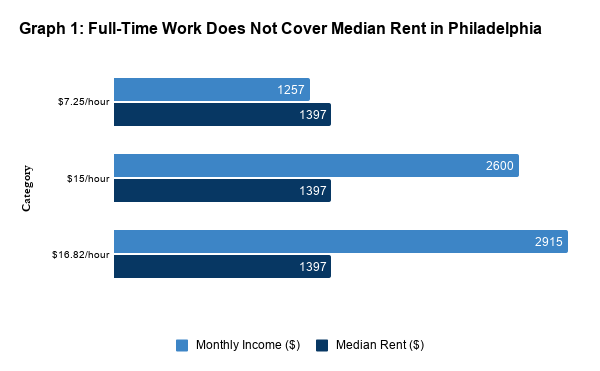
Comparing Monthly Income with Median Rent
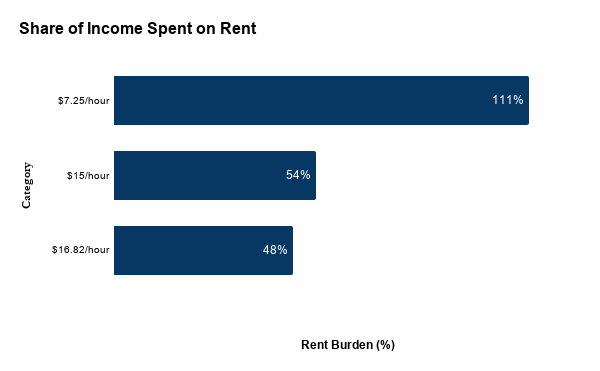
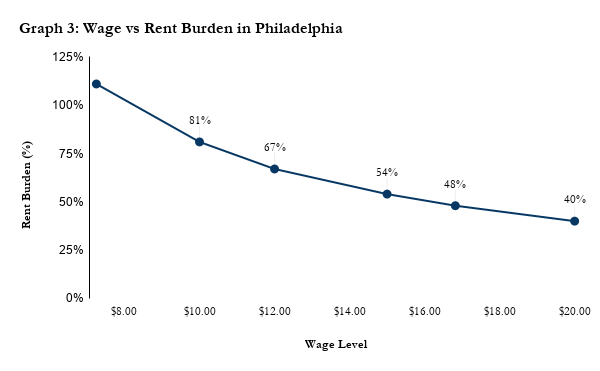
The analysis shows that a full-time worker earning minimum wage cannot afford the median rent in Philadelphia. Despite significant increases in housing, transportation, and everyday living costs over the past decade, Pennsylvania’s minimum wage has remained unchanged at $7.25 per hour since 2009. Even at $15 per hour, rent alone consumes more than half of the average monthly income, illustrating the widening gap between wages and the cost of accessing opportunity in the city.
The Affordability Gap
To answer this question, we compare people's earnings with housing costs. According to the U.S. Census Bureau's 2020–2024 American Community Survey (ACS) five-year estimates, Philadelphia's median gross rent is $1,397 per month. A full-time worker earning Pennsylvania’s minimum wage of $7.25 per hour earns roughly $1,257 per month before taxes. This means that a full-time worker cannot afford rent even before accounting for food, transportation, or basic needs. At $15 per hour, the monthly income rises to approximately $2,600. Rent would still consume more than 50 percent of income, well above the standard affordability threshold of 30%. At $16.82 per hour, the current wage benchmark for certain city-supported workers, rent still accounts for nearly half of the monthly income. This gap is structural, reflecting a persistent mismatch between income and cost.
Income and Work: The Structure Behind the Gap
While wage levels are a central factor, the affordability gap also reflects the structure of available work. Many jobs accessible to residents do not align with the city's cost of living, particularly for housing and transportation. Access to higher-paying jobs is uneven and often shaped by geographic location, access to education, and proximity to reliable public transportation. The issue is not only what people earn, but whether available work provides affordable access to opportunity.
The Cost of Access: A Policy System
At its core, this system reflects a chain of policy decisions. Housing and transportation in Philadelphia do not operate as separate policy domains. They operate as a single system that determines what residents ultimately pay to live and work in the city. This reflects a combined housing and mobility cost structure that determines access to economic opportunity. At the state level, Harrisburg establishes the legal and fiscal environment through planning law and transit funding. These decisions shape how cities manage housing growth and mobility. This includes the authority granted to municipalities under the Pennsylvania Municipalities Planning Code and the level of financial support provided to public transportation systems. At the city level, Philadelphia translates that framework into zoning rules, permitting processes, density limits, and land-use decisions. These rules determine what can be built, where it can be built, and at what scale; in doing so, they shape market outcomes. When housing supply is constrained, rent rises. When development is limited in high-demand, transit-accessible areas, housing shifts outward.
As a result, households are pushed to adjust their location decisions, often moving farther from employment centers to seek affordability. These outcomes are the direct result of policy decisions that constrain housing supply and increase the cost of access. Longer commute times, higher transportation costs, and increased financial strain are direct outcomes of policy-driven scarcity and spatial mismatch. The affordability of housing is shaped not only by rent but by its proximity to jobs, services, transportation infrastructure, and economic opportunity. In practice, households absorb costs that originate upstream in policy decisions.
Zoning and Housing Supply
Zoning policies play a central role in determining the availability, location, and type of housing within a city. In Philadelphia, zoning regulations influence whether housing is developed as single-family homes, multi-unit apartments, or mixed-use developments. These decisions directly affect housing supply. When zoning regulations limit density or restrict certain forms of housing development in high-demand areas, housing supply expansion becomes slower and more constrained, contributing to rising rent levels over time.
At the same time, zoning policies shape where affordable housing is likely to exist. Lower-cost housing is located farther from central economic areas where jobs and services are concentrated. This creates a spatial mismatch between where people can afford to live and where economic opportunities are located. The GER reveals that zoning decisions shape not only housing availability but also the distance between households and opportunity. As a result, housing affordability cannot be separated from location. Zoning decisions not only affect rent levels but also indirectly determine how far households must travel to access employment and essential services.
Public Transit Funding (SEPTA)
Public transit systems, particularly the Southeastern Pennsylvania Transportation Authority (SEPTA) in Philadelphia, play a critical role in connecting residents to jobs, schools, and essential services. The level and structure of public transit funding influence the frequency, reliability, and geographic coverage of transit services. Well-funded transit systems can reduce commuting costs and improve accessibility, particularly for low- and middle-income households.
However, when transit systems face funding constraints, service quality may decline through reduced frequency, limited routes, or delays. In these conditions, distance becomes more expensive. When transit systems are underfunded, affordability shifts from housing to transportation, increasing the total cost of living. Households living farther from employment centers may face higher transportation costs, longer commute times, and less time available for work, family, and rest.
Infrastructure and Commuting
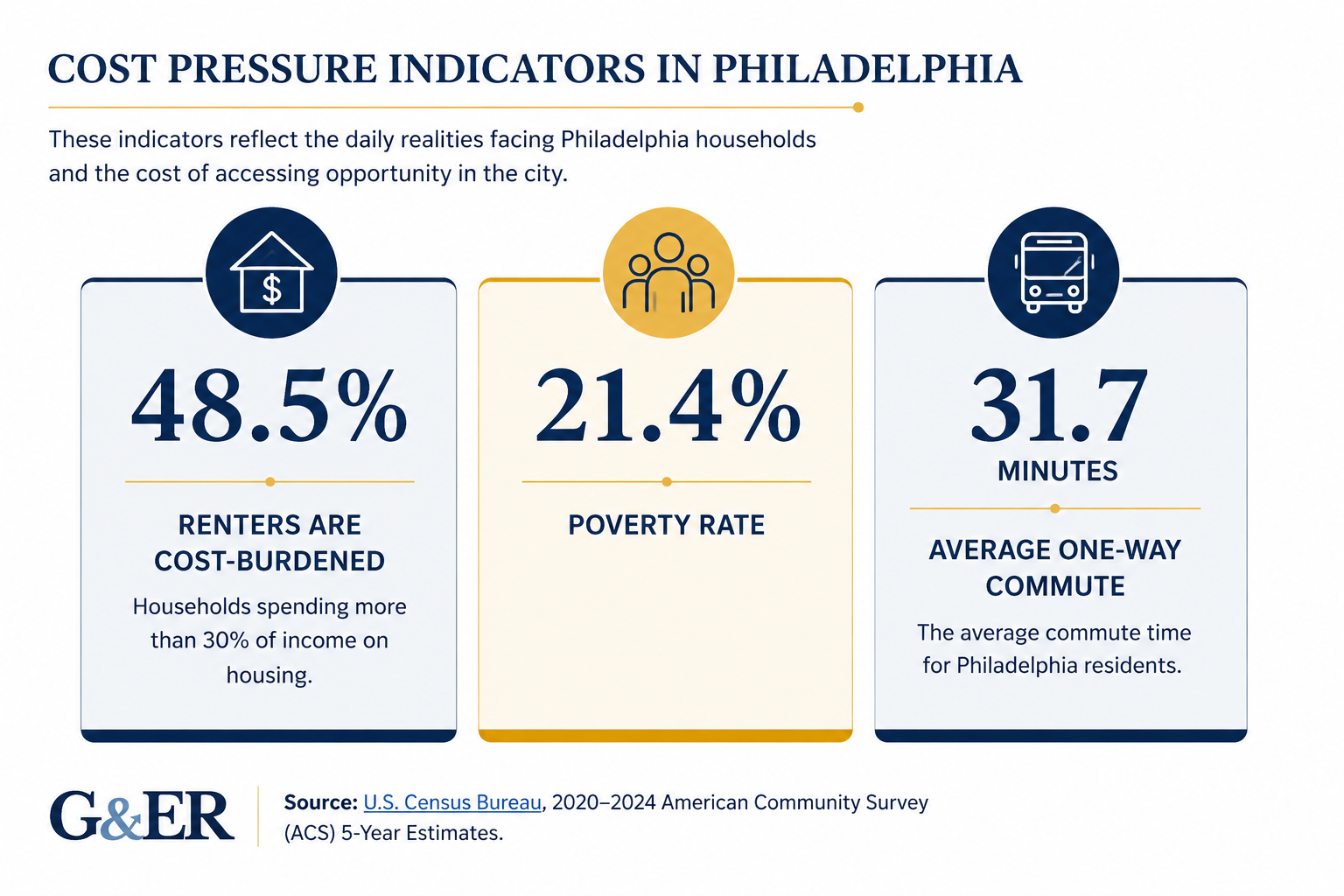
Infrastructure, including road networks, transit routes, and urban connectivity, determines how easily individuals can move between where they live and where they work. In cities like Philadelphia, infrastructure shapes commuting patterns and influences both the time and financial costs associated with daily travel. According to DataUSA, the average commute time in Philadelphia is approximately 31.7 minutes, reflecting the significant role transportation systems play in shaping everyday access to work and economic opportunity.
Longer commuting distances often result in higher transportation costs, including fuel, transit fares, and vehicle maintenance. Beyond financial costs, commuting also carries a time burden. Time spent traveling reduces time available for work, family, and rest, functioning as a hidden economic cost. Infrastructure investments and planning decisions, therefore, influence not only physical mobility but also broader quality of life and economic productivity. In this sense, infrastructure determines whether distance remains manageable or becomes a sustained financial and social burden.
System Integration
These three elements, i.e zoning, public transit funding, and infrastructure, operate as an interconnected system. Zoning determines where people can afford to live, housing costs influence how far they must locate from economic centers, and transportation systems determine how costly that distance becomes. Together, these factors shape the total cost of living. The total cost of living is not defined by rent alone, but by the combined effect of housing and mobility costs. To understand how these outcomes are produced, it is necessary to trace the policy chain from state decisions to everyday life.
State → City → Market → Everyday Life
This reflects a policy-to-experience chain: how decisions made upstream translate into everyday costs and constraints. It begins in Harrisburg, where the state sets the legal and fiscal environment within which cities operate. Under the Pennsylvania Municipalities Planning Code, municipalities are empowered to prepare zoning ordinances, subdivision and land development rules, and related planning regulations. The state does not determine parcel-level outcomes, but it defines the legal framework within which all local zoning systems operate.
The state also shapes mobility through transit funding decisions. In 2025, Governor Shapiro’s transit proposal called for $292 million in new statewide transit funding, and SEPTA warned that without a state solution, it would move ahead with a budget that cut service by 45 percent and raised fares by 21.5 percent to close a $213 million recurring deficit. As of February 2026, SEPTA said new dedicated state funding would allow it to balance its budget and maintain critical service.
That state framework then moves downward into Philadelphia city policy. The City’s current Zoning Code, implemented on August 22, 2012, governs land use, building height and bulk, population density, parking requirements, and the overall character of development. Philadelphia’s Department of Licenses and Inspections issues zoning and change-of-use approvals under that code. What is often described as “the market” is already structured by public rules: what can be built, where it can be built, and at what scale.
Those rules shape market outcomes. Pew reported in 2025 that Pennsylvania ranked 44th among the states in the rate of housing built from 2017 to 2023 and explicitly linked the shortfall, in part, to restrictive zoning regulations. During that same period, local governments issued permits sufficient to expand the state’s housing stock by only 3.4 percent, while the number of households increased by 5.1 percent. Pew’s central conclusion is straightforward: when there are not enough homes to meet demand, housing costs rise. In the 23 Pennsylvania counties it tracked, average rent rose from $1,013 in 2017 to $1,476 in 2023, a 46 percent increase. In Greater Philadelphia, the Delaware Valley Regional Planning Commission (DVRPC) reported that the average asking rent per unit reached $1,653 in April 2023, up 37 percent from January 2013.
Everyday Impact
Those market outcomes then shape everyday life. In practice, this translates into higher rent burdens, longer commute times, and fewer choices about where to live, work, and how to allocate income for households. The evidence indicates that these outcomes are not accidental. They are the direct result of policy decisions that constrain housing supply and increase the cost of access. In Philadelphia, nearly half of renters (48.5%) are cost-burdened, meaning they spend a significant share of their income on housing. The city’s mean travel time to work is 31.7 minutes. Median household income is $61,953, and the poverty rate is 21.4 percent.
For lower-income workers, the affordability gap is even more severe. When rent alone consumes over 50 percent of income, transportation costs become the deciding factor in whether households can sustain employment. When households cannot afford housing near jobs or reliable transit, they face a tradeoff: pay more to live closer in, or move farther out and absorb higher transportation costs. The evidence indicates that this tradeoff shifts cost from housing to mobility rather than reducing the total cost of living.
As of March 27, 2026, the American Automobile Association (AAA) listed the average Pennsylvania gas price at $3.945 per gallon. Even modest increases in driving can therefore convert housing scarcity into recurring household stress through fuel spending, time loss, and reduced flexibility for work, school, and care obligations.
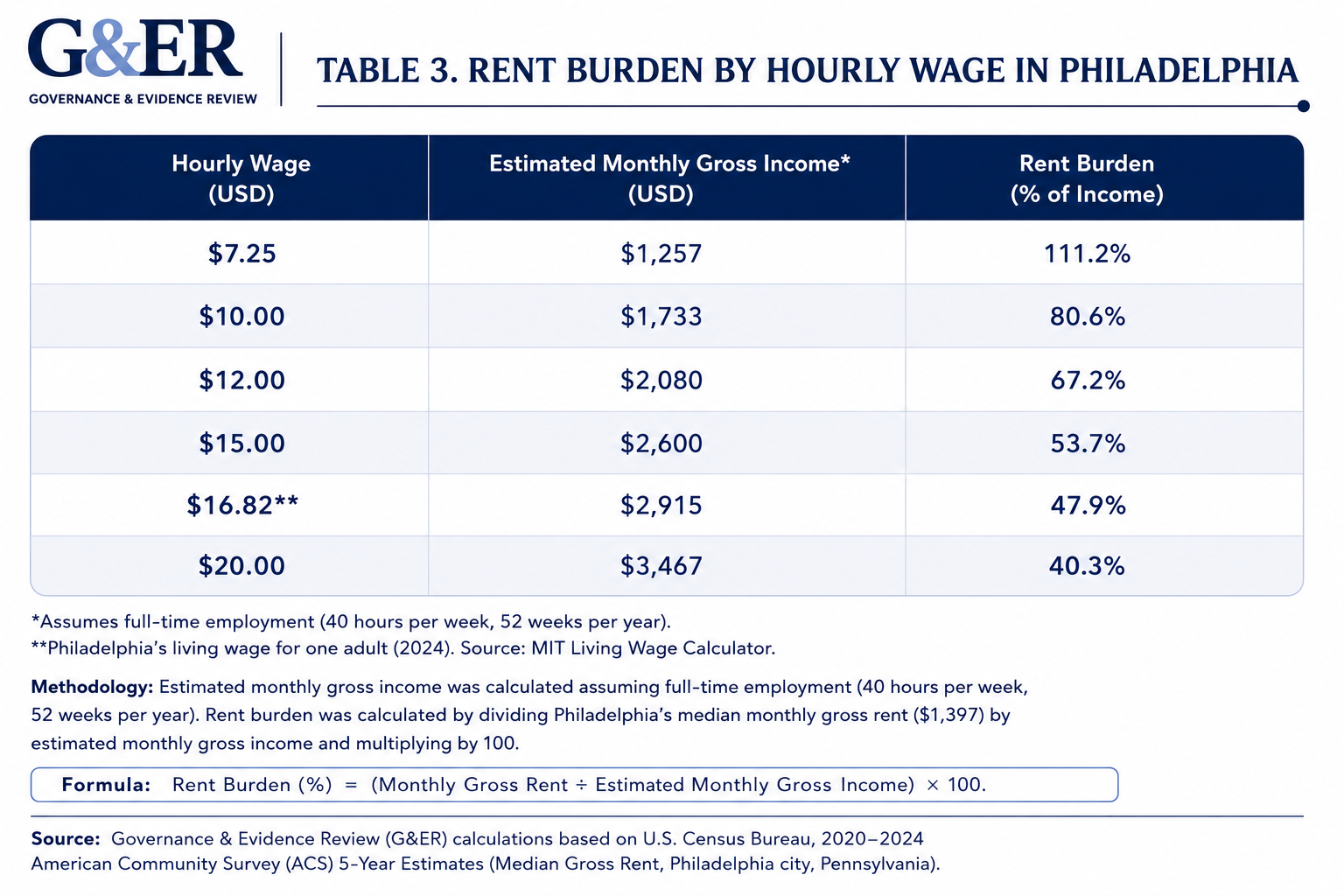
Wage Vs Rent Burden In Philadelphia
Housing affordability pressures are not evenly distributed across wage levels. As hourly wages increase, the share of monthly gross income required to pay Philadelphia's median gross rent declines substantially. Workers earning lower wages experience significantly higher rent burdens, leaving households with less income available for transportation, food, healthcare, childcare, and other essential household expenses.
These findings point to several areas for consideration. This includes improving transparency on rent-to-income ratios at the neighborhood level, prioritizing housing development near transit rather than in isolation, and holding local officials accountable to a basic question: can a full-time worker afford to live here?
From System Diagnosis to Policy Reform: What Policies Should Change?
These constraints shape whether communities remain stable, whether families can remain in place, and whether opportunity is accessible or out of reach. If the cost of living in Philadelphia is shaped by a policy system, then reducing that cost requires intervention across that same system. Housing affordability and transportation access cannot be solved through isolated fixes. The problem is structural: a misalignment between housing supply, location, and mobility that policy has reinforced over time. Policy reform must therefore operate at three levels: state policy (Harrisburg), city policy (Philadelphia), and system coordination between housing and transportation.
1. State-Level Reform: Align Funding with Mobility Needs
At the state level, the most immediate constraint is public transit funding. SEPTA remains heavily dependent on state allocations to maintain service levels. When funding is unstable or insufficient, the system compensates through service cuts, fare increases, or both. These adjustments disproportionately affect low- and middle-income households that rely on transit for daily mobility. Reform efforts should prioritize predictable transit funding, reduced reliance on short-term negotiations, and protection of service frequency and coverage. The goal is to ensure that distance does not automatically translate into a higher cost. Without reliable transit, even modestly affordable housing becomes functionally expensive.
2. State-Level Reform: Enable Housing Supply Through Legal Frameworks
The state also shapes housing indirectly through the legal authority it grants municipalities. The Pennsylvania Municipalities Planning Code provides the foundation for local zoning. While municipalities control implementation, the state can influence how flexible or restrictive these systems become. A stronger approach would include encouraging pro-housing zoning practices, limiting overly restrictive local regulations that constrain supply, and incentivizing development near transit corridors. This does not require removing local control. It requires ensuring that local decisions do not collectively produce a statewide housing shortage.
3. City-Level Reform: Increase Housing Supply Where Access Already Exists
At the city level, zoning and permitting remain among the most significant policy tools shaping housing availability and urban development. Zoning regulations influence what types of housing can be built, where development can occur, and the scale at which neighborhoods can grow. Philadelphia has already undertaken major zoning reform, but important debates remain regarding density, multi-unit development, and housing growth within high-demand and transit-accessible areas. City policy discussions increasingly focus on expanding housing options in well-connected neighborhoods, supporting mixed-use and multi-unit development, and streamlining permitting processes to reduce delays associated with new housing construction.
When housing availability remains constrained in areas with strong job access and transit connectivity, affordability pressures may increase within those neighborhoods over time. In practice, many households relocate further from concentrated employment centers in search of lower housing costs, often absorbing longer commute times and additional transportation-related expenses in the process. As a result, lower housing costs in geographically disconnected areas do not always translate into lower overall living costs once transportation and commuting burdens are considered.
4. City-Level Reform: Integrate Housing and Transportation Planning
One of the core failures in the current system is that housing and transportation are often planned separately. In practice, they function as a single system. State intervention could support aligning zoning decisions with transit infrastructure, prioritizing development along existing transit corridors, and coordinating land use planning with transit service planning. This approach recognizes a simple reality: Housing is only affordable if it is accessible. A lower rent in a poorly connected area may result in a higher total cost of living once transportation is included.
5. System-Level Reform: Shift from “Housing Cost” to “Cost of Access.”
The most important reform is conceptual: shifting from measuring housing cost to measuring the cost of access. Policy discussions often focus narrowly on rent levels. But as this analysis shows, the true burden on households is the combined cost of housing and mobility. A coordinated strategy would require measuring affordability using combined housing and transportation costs, incorporating commute time and access into policy evaluation, and designing policies that reduce total cost rather than focusing on rent alone. This shift changes how policy success is defined. A policy that lowers rent but increases commute time may not improve affordability. A policy that improves transit access may reduce total cost even if rent remains stable.
Housing affordability is not just about rent. It is about the cost of access to opportunity.
Part 3: Why Reform Is Hard
From Policy Design to Political Reality
If the solutions to housing affordability and transportation access are relatively clear, why do these problems persist? The constraint is not technical complexity alone. It is political, shaped by incentives, institutions, and competing interests across levels of government. Reforming the cost of the access system requires more than good policy ideas. It requires navigating trade-offs that are often politically difficult to resolve.
1. Local Resistance to Housing Growth
At the city level, one of the most consistent barriers to increasing housing supply is local opposition to development. Zoning decisions are not made in a vacuum. They are shaped by residents, neighborhood groups, and political considerations. Proposals to increase density, allow multi-unit housing, or reduce parking requirements often face resistance from communities concerned about neighborhood character, congestion and parking availability, and property values. These concerns are politically powerful. Even when increasing housing supply would improve affordability at a citywide level, local opposition can delay or block projects. As a result, the areas where housing is most needed, namely high-demand, transit-accessible neighborhoods, are often the hardest places to build.
2. Fragmented Authority Between State and City
The system you described is split across levels of government.
The Pennsylvania General Assembly controls funding and legal frameworks
Philadelphia controls zoning and permitting
SEPTA operates transit but depends on state funding
This fragmentation creates a coordination problem. For example, the city can support transit-oriented development, but without sufficient state funding, transit service may decline. Similarly, the state can enable housing reform, while local implementation may remain restrictive. No single actor controls the full system. That makes comprehensive reform difficult to achieve.
3. Short-Term Political Incentives vs Long-Term Gains
Many of the reforms discussed in Part 2 produce long-term benefits but short-term political costs. For example, increasing housing density may face immediate community opposition, expanding transit funding may require new revenue sources or budget tradeoffs, and zoning reform may disrupt existing expectations about land use. Elected officials often operate within short election cycles. Policies that create visible disruption today, even if they deliver benefits later, can be politically risky. As a result, incremental or delayed action is often more politically feasible than structural reform.
4. The Invisible Nature of the Problem
Another challenge is that the cost of access is not always visible as a single issue. Residents experience high rent, long commutes, and rising transportation costs. These are often treated as separate problems, rather than as outcomes of a single policy system. Because the issue is fragmented in public perception, housing policy debates focus on rent, transit debates focus on service, and infrastructure debates focus on congestion, making it harder to build a unified political response.
5. Tradeoffs Between Equity, Growth, and Stability
Finally, reform requires balancing competing goals: expanding housing supply, preserving neighborhood stability, ensuring equitable access to opportunity, and managing infrastructure capacity. These goals do not always align neatly. For example, rapid development may increase supply but raise concerns about displacement, while transit investment may improve access but require reallocating limited public funds. Policy decisions must navigate these tradeoffs, and different stakeholders prioritize them differently.
Conclusion: Reform Requires Political Strategy, Not Just Policy Design
Philadelphia’s affordability crisis is not just a housing problem. It is the gap between what work pays, what housing demands, and what it costs to access opportunity. As long as full-time workers cannot afford to live near opportunity, the system will continue shifting costs onto households through longer commutes, higher transportation expenses, and reduced economic mobility.
The issue is no longer whether housing is expensive. It is whether work provides access to opportunity at all, and for many, it does not.
© 2026 Governance & Evidence Review. All rights reserved.