
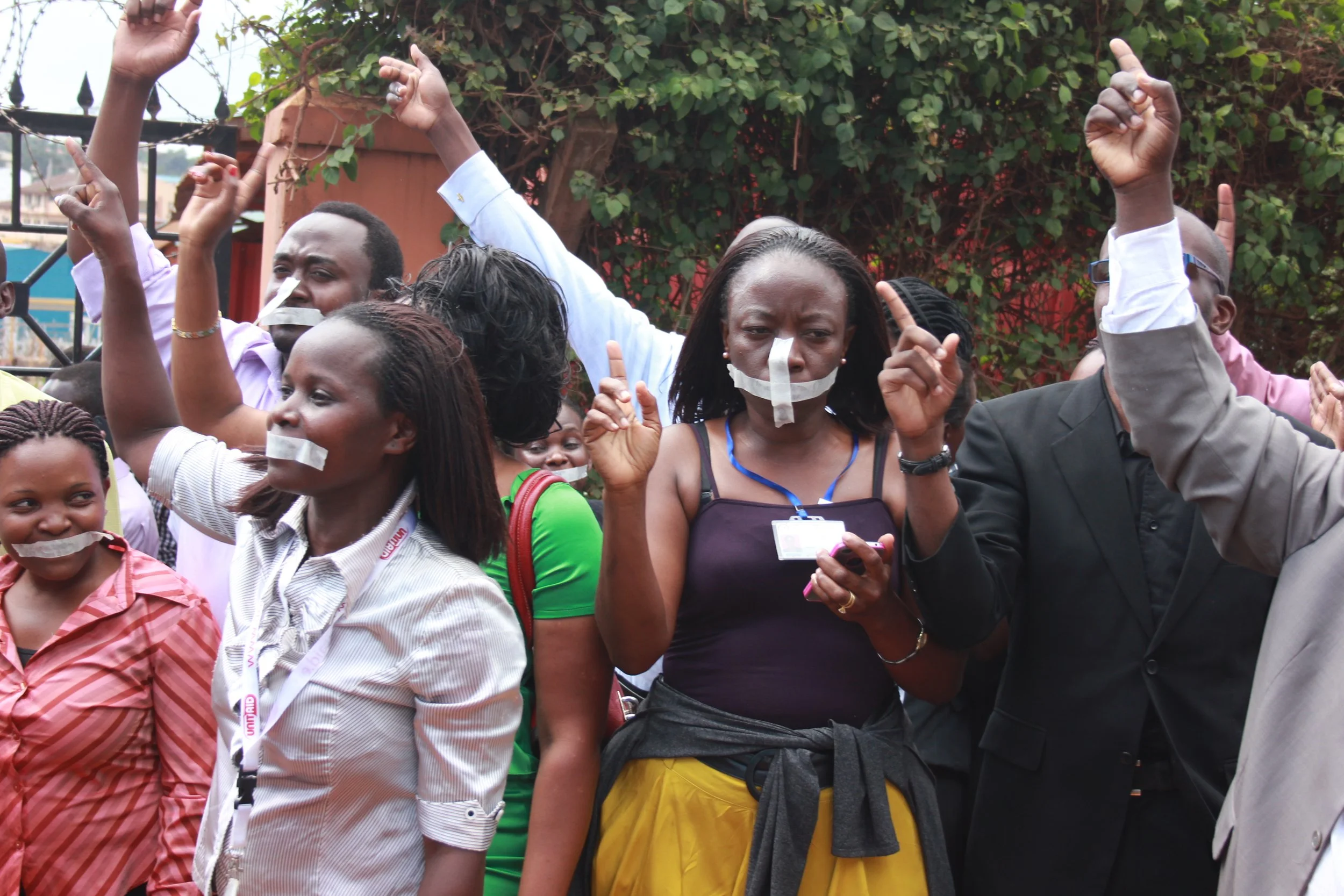
Photo Credit: Human Rights Network for Journalists Uganda- HRNJ
Uganda has an impressive legal framework, like the Constitution of the Republic of Uganda 1995, chapter four of which highlights the fundamental human rights enjoyed by Citizens. Other laws include: the Access to Information Act 2005, Whistleblowers Act 2010, Anti-Corruption Amendment Act 2015, Anti-Torture Act, among others.
The country prides itself on having an institutional framework supporting implementation, monitoring, and reporting of laws, namely, the Uganda Human Rights Commission (UHRC), whose mandate is spelt out in Article 52 of the Constitution, accredited with A status by the International Coordinating Committee of National Human Rights Institutions.
Law enforcement agencies like Uganda’s National Police Force have a Directorate of Human Rights and legal services, while the Uganda People's Defense Force (UPDF) has a human rights department. Furthermore, Uganda has courts of law that administer justice and safeguard human rights. Through her institutional framework, like the Uganda Human Rights Commission, Ugandans are sensitized on their human rights, access, and protection thereof.
Overview of human rights performance in Uganda
Despite the legal, institutional, and policy mechanisms, Uganda’s human rights performance remains dismal as human rights are under siege. The Global Integrity report 2011, conducted in 31 countries, highlighted Uganda as having a low implementation gap with a score of 52%, with an excellent legal framework awarded at 98%, giving the country an implementation gap of 46%.
In Uganda, leaders have succeeded in inculcating the minds of the citizens that human rights are no longer entitlements but tokens and privileges dangled out by the leaders. For example, while Ugandans have the right to freedom of association, expression, and movement as guaranteed by the Constitution of the Republic of Uganda, it has controversial laws like the Public Order Management Act 2013 and the NGO Act 2016, which could rob citizens of their rights.
The POMA requires citizens to seek permission from the police to hold a public gathering, which permission is often selectively or never guaranteed. Concerns about violations of freedom of association, assembly, and expression continued during and after Uganda’s February 2016 elections, where the leaders of the opposition were not allowed to gather for their cause, and the arrest of citizens under the guise of idleness. Institutions like the Uganda National Police Force, Uganda People's Defense Force, and Courts, which are supposed to safeguard human rights, are commonly cited at the center of the abuse.
During the 2016 elections, disenfranchisement of voters due to late delivery of polling materials in Kampala and Wakiso was cited, disenfranchisement of Ugandans in the diaspora, detainees, media were unable to operate freely, and journalists were attacked and restricted while covering the elections, limited freedom of assembly, especially for opposition candidates and supporters, and excessive use of force by security agencies. This could be interpreted to mean that human rights are no longer inalienable but offered piecemeal.
Despite having documentation of numerous human rights atrocities in Uganda, data sets on human rights reporting seem invisible. This alone can bring bias in human rights reporting, limit action on human rights injustices by interested actors, and hinder awareness creation efforts.
Current Reality
Uganda has numerous human rights activists and agencies finding difficulty in accessing human rights data sets, as each party i.e activists and government, has an independent database for individual use.
With access to data by selected individuals and agencies, information could be used for selfish interests while limiting the additional pathways to raise awareness of human rights issues, like describing a vivid story and sparking grassroots advocacy initiatives, while grounding these issues within a local context rather than relying so heavily on international initiatives with a Western lens.
On the other hand, the lack of a centralized human rights database affects human rights monitoring and reporting as each party interprets and reports what they have, but not what is actually on the ground.
Whereas the Uganda Human Rights Commission (UHRC) is mandated to document cases of human rights abuses throughout the country, its work and operation are curtailed by limited funding and staffing. As a result, instead of carrying out independent documentation, UHRC relies on police records and cases only brought forward and registered in their offices.
Furthermore, even civil society actors seem to operate in isolation, each with its own data. This makes the national outlook on human rights reporting incomplete.
How open data strengthens human rights reporting and awareness creation.
To curb human rights violations, open data advocacy and data analysis should be applied in reporting human rights violations. Good data analysis by human rights groups will help bolster litigation cases, and technology will provide free and open access to the data that governments and the public possess.
Access to data can make it more widely and effectively used in cases. With increased access, data could be open to analysis by a larger range of actors, including a variety of local human rights groups, which could help mitigate bias. With few people accessing human rights violation data, it is much easier to paint a subjective picture within a court of law.
Therefore, using data to tell a story, analysis, visualization, and reporting can play a huge role in stimulating grassroots engagement campaigns or legislative policy advocacy. The result can present an opportunity to utilize these strategies to monitor human rights.
Conclusion
Having a central database for human rights violations in Uganda is important to ease access to human rights violation cases by human rights groups, Journalists, state agencies, and the general public as a whole. While all actors i.e Civil Society, Journalists, and state agencies, may be inputting cases in the data portal, with centralized information, it’s anticipated that the government will ease access to justice for the human rights victims.
With the database, parties will be able to hold others accountable because performance benchmarks will be accessed by all i.e rate of disposing off cases, access to justice, and evidence-based data-driven compelling stories will be produced by the media without bias.

