
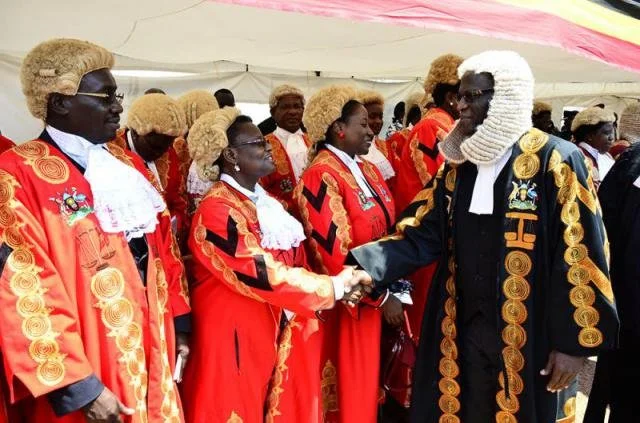
Justice Steven Kavuma greets Justice Anglin Flavia Senoga at his arrival to grace the opening of the New Law Year at the High Court in Kampala (Photo: RedPepper)
On a Wednesday afternoon, I participated in a dialogue on strengthening judicial transparency and accountability in Uganda, at Makerere University, Kampala.
During discussions, a private practitioner emphasized open justice as a requisite for strengthening transparency and accountability in Uganda’s judiciary. Open justice is a core principle of the common law. It relates information on what happens in courts to other aspects of democratic governance and the rule of law. In safeguarding public access to information about courts and their activities, open justice provides a set of principles that facilitate other liberal democratic values i.e the right to know the law and to understand its application, the salutary effects of permitting citizens to observe and evaluate the operation of government, and repugnance for arbitrary power.
What Uganda is currently doing in relation to open Justice
In Uganda, journalists are allowed to attend court hearings, as they are the eyes and ears of the general public who are not able to attend. This was evident when the High Court of Uganda ordered the trial of Ronald Poteri, a police detective accused of leaking secret audio recordings between the Ugandan Inspector General of Police and youths from the ruling National Resistance Movement Party, to be open to journalists and the public. The ruling emphasized the importance of the media as a watchdog of justice and recognized their vital significance in ensuring that the principle of open justice is observed. The judiciary is obliged to ensure that journalists report court cases to enhance public knowledge and secure their confidence in court processes.
However, with growing corruption trends in Uganda’s justice delivery institutions, coupled with a lack of access to court information, transparency, and accountability violations continue owning the day in Uganda’s temples of justice. It’s not news for the judiciary and police to champion corrupt institutions in Uganda and the East African region.
The information gap between Uganda’s judiciary and citizens is responsible for the loss of citizens’ trust not only in the institutions but also in people holding judicial office. In principle, open justice entails that information about court proceedings is widely accessible and may be subject to discussion and critical analysis, which is an important ingredient of the rule of law and fundamental to democratic governance.
Accessibility of information about courts and their activities is a necessary correlate to the principle that it should be possible to know the law, and helps safeguard the principle that citizens should be equally subject to the law.
In his speech during the Commonwealth Magistrates and Judges Conference 2012, Uganda’s chief justice highlighted that effective communication by judges is essential in expanding the frontiers of justice to a vast majority of the population, which is excluded from the justice system due to miscommunication by judges. It’s also a common practice in Uganda for magistrates to use technical language and jargon while communicating to the public i.e N/C to mean non-cash bail, which is misinterpreted by citizens who pay cash instead. Nonetheless, the money is also accepted by judicial officials, though never reciept-ed.
Judges have been accused of speaking softly, being verbose and legalistic, and being mindless about the needs of the litigants. Some judgments are overloaded with information, and yet others are complex to comprehend. These overloads create barriers to the effective administration of justice and affect open justice.
“ Indeed, sections of the public submit to this intimidation and back off. They claim that the broader picture however, is that the public generally appears ignorant, at least from face to face interviews from selected jurisdictions, on among others, how to report corruption cases, court procedure and their rights, all of which offer a fertile breeding ground for the appetite of the officers to corrupt the system and even institutionalize malpractices”.
With open justice, citizens can know how well courts manage cases and testimonies. Transparency in the information available to the judicial system is a key to guarantee a fair process for all citizens, and supports the principle of equality strongly.
What Uganda’s judiciary needs to do to improve open Justice
Uganda’s temples of justice are supported by the taxpayers, and therefore, cannot run away from results. Judicial officers must become high-performance managers guided by principles of client focus, continuous improvement, and quality.
“ There is growing concern that public sector institutions including the Judiciary are not delivering results. Public confidence in the Judiciary is low because of inefficiency -giving room to growth of alternative dispute resolution mechanisms to fill the void left by the courts. The shrinking space and relevance of the courts in the arena of dispute resolution is a symptom of a deep-seated inefficiency within the justice system, which is perceived as being incapable of making decisions expeditiously”.
Open Justice enables the public to see how justice is administered, and by subjecting it to public and press scrutiny, safeguards the fairness of the trial. Therefore, people should be entitled to a reasoned judgment that has to be made public.
Open Justice requires people to be informed of the reasons for their arrest and any pretrial detention. They must also be given information on their rights as a suspect. Without this information, conveyed in a language the person understands, rights that exist in law but are illusory in practice.
